Skip to content




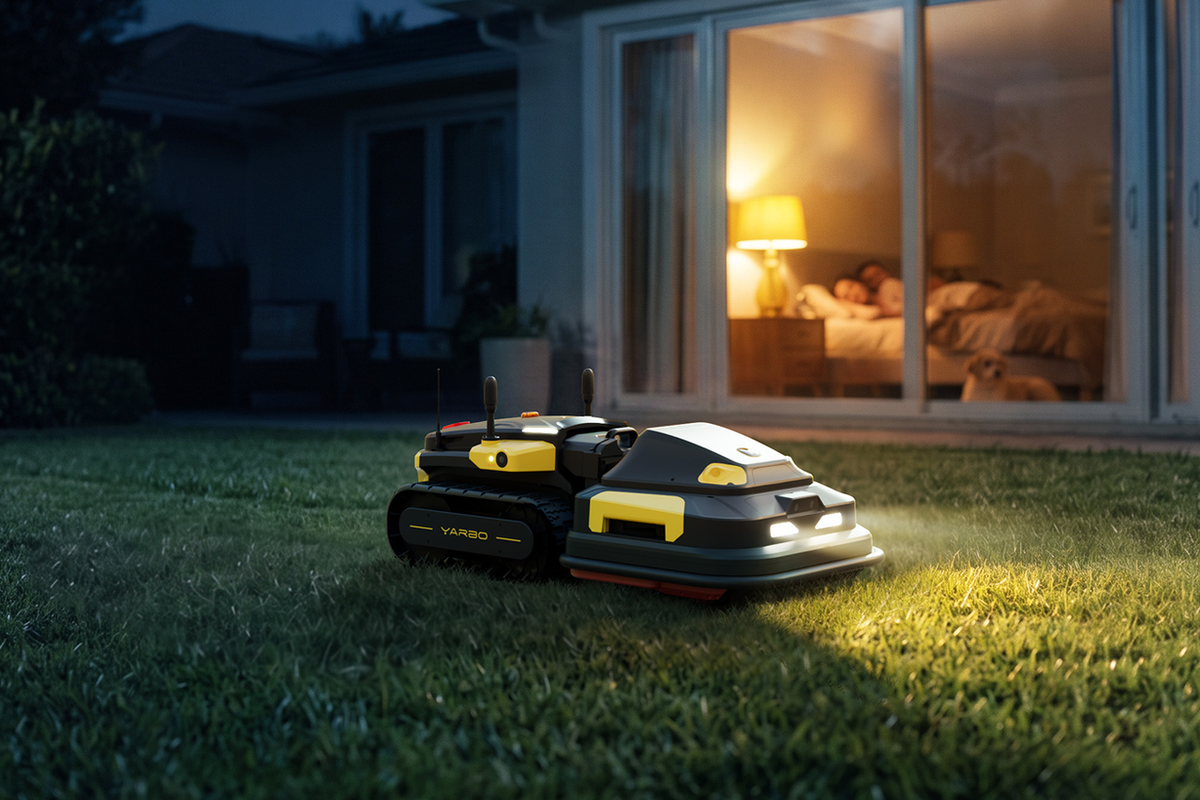
Table Of Contents
When people shop for an automated lawn mower, they compare coverage area, navigation technology, and price. Almost nobody asks what kind of motor is driving the wheels.
That's a mistake. The drivetrain determines how the machine handles slopes, how quietly it runs, and how long it lasts before something wears out. And right now, hub motors are changing what's possible in this category.
How Robot Mowers Are Driven — and Why It Matters
Many robot mowers use a gearbox-driven system between the motor and the wheel. The motor spins fast; the gearbox converts that into usable torque at the wheel. It's a proven, reliable approach — and for standard residential lawns with moderate terrain, it does the job well. The Y40 is built on exactly this system, and for straightforward yards, it's the right fit. Where gearbox systems face more demand is in sustained high-load conditions: steep slopes, thick grass, and large properties running the machine daily. The more complex the yard, the more a simpler drivetrain starts to matter.
What a Hub Motor Does Differently
The gearbox-free dual hub motor system means fewer moving parts in the drivetrain overall. That translates to smoother, faster, and quieter operation at working speeds — and a drivetrain that handles varied load conditions with less mechanical complexity. That's not an incidental effect — it's one of the more practical advantages of the design for households that want to schedule mowing on their own terms.
Why Quiet Operation Changes How You Use the Machine
Quieter operation is a direct result of how hub motors work — without gear mesh friction in the drivetrain, the high-frequency mechanical whining is eliminated, making the sound profile at working speed fundamentally gentler. A robot mower that runs at around 60 dB — close to normal conversation level — is quiet enough to fade into the background. That single characteristic changes how the machine fits into daily life.
Early morning before the neighborhood wakes up. Late evening after the kids are in bed. Times that a louder machine would make uncomfortable become viable scheduling windows. For households that want genuine set-and-forget automation, that flexibility is what makes the promise actually livable day to day.
What This Means on a Slope
While quietness improves daily life, the critical engineering advantage of a hub motor on uneven terrain is its instantaneous torque delivery. Eliminating physical gears allows the system to send power directly to the tracks with no lag. When a hub motor automated lawn mower hits a grade change — a drainage ditch, a slope transition, a patch of dense wet grass — the wheel response is faster and more precise than a geared system allows.
That translates directly to hill-climbing stability. The machine holds its intended path rather than slipping or overcorrecting, which matters on the kind of varied, multi-zone properties where robot mowers earn their keep.
The Yarbo Y40P's Approach
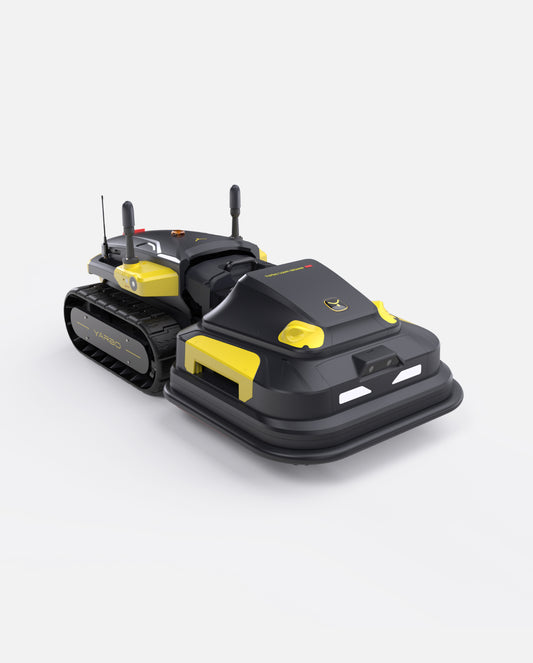
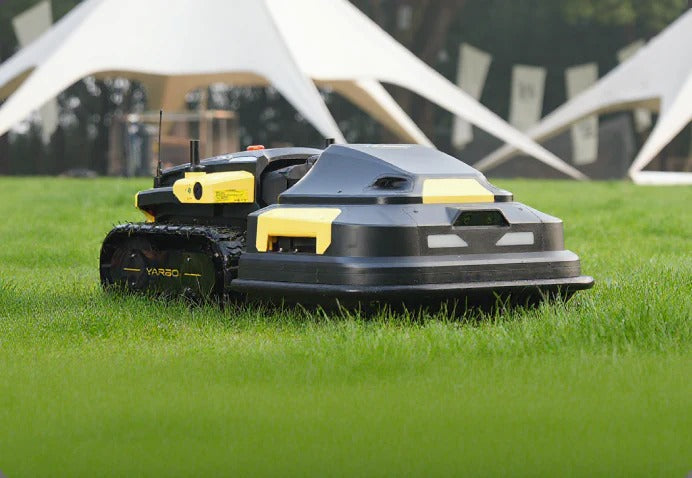
The Y40P is built around a gearbox-free dual hub motor drive system. Even at higher working speeds, it's designed to stay quiet enough that what stands out is the machine moving through your yard, not the sound of its motor — with measured operating noise around 60 dB, close to normal conversation level.
That makes early-morning or evening scheduling a more comfortable option for most households — and supports the kind of autonomous, low-intervention operation that large-property owners are actually looking for in an automated lawn mower.
The efficiency gains are measurable too. The Y40P covers up to 0.3 acres per charge (vs 0.25 acres on Y40), 2 acres per day (vs 1.7 acres on Y40), and 7 acres weekly (vs 6 acres on Y40). In mowing operation, its higher working speed delivers 53% more ground covered per hour compared to the Y40 — fewer recharge stops, more yard finished per session.
For owners who want higher efficiency and minimal intervention on more complex, demanding terrain, the Y40P's hub motor system is where that level of performance starts.
See the full robot lawn mower collection for models across different terrain and coverage needs.
FAQ
What is a hub motor in a robot mower?
A hub motor is a direct-drive motor built into the wheel hub. It drives the wheel without a gearbox, resulting in fewer moving parts, lower noise, and reduced mechanical wear over time.
Are hub motor robot mowers quieter?
Yes. The direct-drive design reduces drivetrain noise at the source. The Yarbo Y40P runs at measured operating noise around 60 dB — close to normal conversation level — quiet enough for early morning or evening scheduling without disturbing the neighborhood.
Are hub motor robot mowers more durable?
A direct-drive hub motor system has fewer moving parts in the drivetrain overall, which means fewer components accumulating wear over extended use. For high-frequency, demanding-terrain operation, that simplicity has real long-term advantages.
Table Of Contents
Subscribe
- Afghanistan+93
- Albania+355
- Algeria+213
- Andorra+376
- Angola+244
- Antigua and Barbuda+1268
- Argentina+54
- Armenia+374
- Aruba+297
- Australia+61
- Austria+43
- Azerbaijan+994
- Bahamas+1242
- Bahrain+973
- Bangladesh+880
- Barbados+1246
- Belarus+375
- Belgium+32
- Belize+501
- Benin+229
- Bhutan+975
- Bolivia+591
- Bosnia and Herzegovina+387
- Botswana+267
- Brazil+55
- British Indian Ocean Territory+246
- Brunei+673
- Bulgaria+359
- Burkina Faso+226
- Burundi+257
- Cambodia+855
- Cameroon+237
- Canada+1
- Cape Verde+238
- Caribbean Netherlands+599
- Central African Republic+236
- Chad+235
- Chile+56
- China+86
- Colombia+57
- Comoros+269
- Congo+243
- Congo+242
- Costa Rica+506
- Côte d’Ivoire+225
- Croatia+385
- Cuba+53
- Curaçao+599
- Cyprus+357
- Czech Republic+420
- Denmark+45
- Djibouti+253
- Dominica+1767
- Dominican Republic+1
- Ecuador+593
- Egypt+20
- El Salvador+503
- Equatorial Guinea+240
- Eritrea+291
- Estonia+372
- Ethiopia+251
- Fiji+679
- Finland+358
- France+33
- French Guiana+594
- French Polynesia+689
- Gabon+241
- Gambia+220
- Georgia+995
- Germany+49
- Ghana+233
- Greece+30
- Grenada+1473
- Guadeloupe+590
- Guam+1671
- Guatemala+502
- Guinea+224
- Guinea-Bissau+245
- Guyana+592
- Haiti+509
- Honduras+504
- Hong Kong+852
- Hungary+36
- Iceland+354
- India+91
- Indonesia+62
- Iran+98
- Iraq+964
- Ireland+353
- Israel+972
- Italy+39
- Jamaica+1876
- Japan+81
- Jordan+962
- Kazakhstan+7
- Kenya+254
- Kiribati+686
- Kosovo+383
- Kuwait+965
- Kyrgyzstan+996
- Laos+856
- Latvia+371
- Lebanon+961
- Lesotho+266
- Liberia+231
- Libya+218
- Liechtenstein+423
- Lithuania+370
- Luxembourg+352
- Macau+853
- Macedonia+389
- Madagascar+261
- Malawi+265
- Malaysia+60
- Maldives+960
- Mali+223
- Malta+356
- Marshall Islands+692
- Martinique+596
- Mauritania+222
- Mauritius+230
- Mexico+52
- Micronesia+691
- Moldova+373
- Monaco+377
- Mongolia+976
- Montenegro+382
- Morocco+212
- Mozambique+258
- Myanmar+95
- Namibia+264
- Nauru+674
- Nepal+977
- Netherlands+31
- New Caledonia+687
- New Zealand+64
- Nicaragua+505
- Niger+227
- Nigeria+234
- North Korea+850
- Norway+47
- Oman+968
- Pakistan+92
- Palau+680
- Palestine+970
- Panama+507
- Papua New Guinea+675
- Paraguay+595
- Peru+51
- Philippines+63
- Poland+48
- Portugal+351
- Puerto Rico+1
- Qatar+974
- Réunion+262
- Romania+40
- Russia+7
- Rwanda+250
- Saint Kitts and Nevis+1869
- Saint Lucia+1758
- Saint Vincent and the Grenadines+1784
- Samoa+685
- San Marino+378
- São Tomé and Príncipe+239
- Saudi Arabia+966
- Senegal+221
- Serbia+381
- Seychelles+248
- Sierra Leone+232
- Singapore+65
- Slovakia+421
- Slovenia+386
- Solomon Islands+677
- Somalia+252
- South Africa+27
- South Korea+82
- South Sudan+211
- Spain+34
- Sri Lanka+94
- Sudan+249
- Suriname+597
- Swaziland+268
- Sweden+46
- Switzerland+41
- Syria+963
- Taiwan+886
- Tajikistan+992
- Tanzania+255
- Thailand+66
- Timor-Leste+670
- Togo+228
- Tonga+676
- Trinidad and Tobago+1868
- Tunisia+216
- Turkey+90
- Turkmenistan+993
- Tuvalu+688
- Uganda+256
- Ukraine+380
- United Arab Emirates+971
- United Kingdom+44
- United States+1
- Uruguay+598
- Uzbekistan+998
- Vanuatu+678
- Vatican City+39
- Venezuela+58
- Vietnam+84
- Yemen+967
- Zambia+260
- Zimbabwe+263
You have successfully subscribed!!
Check your welcome email for exclusive discounts.
Email Check Needed
We are unable to verify your email address.
Please check if the email
is correct.